
Why It Is Time To Leave Chromium/Chrome/Edge
Chrome owns nearly 70% of the browser market. Currently Google is forcing the retirement of "Manifest v2" in favor of v3. This will significantly impact your ability to block ads and tracking, and is a loud alarm bell telling you to change browsers right now.

In the internet browsing ecosystem, the browsers are represented by two separate yet divergent groups. The browsers who embrace personal privacy and security, and those who side with advertisers and trackers. These are their stories. (with apologies to Law and Order)
I was there when Netscape and Mosaic appeared on the scene. Back when you needed to use an FTP server to get your browser: your OS didn't have one yet that you could use to install a different one with. The graphics were so low res that the logo and menus often took up more of the screen than the actual webpages they were showing you. And browsers had but one purpose: to transform the 99.9% text-based, green-screen friendly Internet of the early 90's to the technicolor, visually appealing (well, sort of) multimedia cornucopia that only sci-fi writers really thought would happen. They were innocent applications, focused on letting you navigate to information and entertainment destinations on the world wide web.
Today they're the battleground on which a vast privacy vs. monetization battle occurs. On the one side we have you, the humble Internet browser. You're still trying to get to information and entertainment. On the other side, we have the people who want to make money off of your actions. They do this in two key ways:
- Advertising. Yes, every pop-up, embedded ad, auto-play video is there in hopes of getting the website that you went to a couple of pennies to rub together in order to do anything from just cover costs to make bank.
- Tracking. You see, "blind" advertising was determined decades ago to be inefficient. Heck, even when TV and radio were young, advertisers were trying to gauge audience demographics to figure out which shows and timeslots they should advertise their products on. The Internet gave them the chance to track you specifically and try to tailor their advertising to you specifically. And they make money by sharing these insights with other advertisers as well.
So what did we consumers do? Well, some of us built browser extensions that combat these intrusive ads and the insidious tracking that go hand-in-hand. You've probably heard of one or more of them. And so there was a sort of equilibrium achieved, sort of a stalemate, which has been relatively stable for over a decade.
Enter Manifest v3
You may have heard about this, and perhaps you haven't. But Manifest v3 is changing how extensions can interact with browsers. Much of this is a good thing: extensions currently have shocking liberty to do a lot of creative things in the browser, and that can include plenty of malicious shenanigans. This will cut down on that and likely save some folks from a bad time. But this also significantly reduces the ability for ad and tracking blocking solutions to work. Let's go through it at a non-technical level.
Starting With Who Owns the Major Browsers
Using the wayback machine, browsers were developed by organizations that had a vested interest in the WWW working. Mosaic was developed by the "National Center for Supercomputing Applications" at the University of Illinois. Netscape was developed by someone who left the NCSA, and eventually made their code open source and becoming Mozilla which later begat Firefox.
Then came Internet Explorer from Microsoft, Safari from Apple, and Chrome from Google. These three effectively killed off those earlier browsers, mainly based on one of them having ridiculous brand recognition from their search business, and the other two being preinstalled on hardware shipped directly to consumers. So the three most popular browsers in use today all come from mega-corporations who have their hands in almost every aspect of computing, from smart phones to cloud platforms to advertising and search.
And then the impossible happened: Microsoft ditched their own browser development for a fork of the Chromium browser that underpins Chrome, effectively bringing the number of unique browsers down by one more. (This was undoubtedly a good thing in many ways, the old Internet Explorer architecture needed to be blown up and started over it was so poorly cobbled together after decades of slapping on new functionality without fixing the old, but as with everything there are tradeoffs)
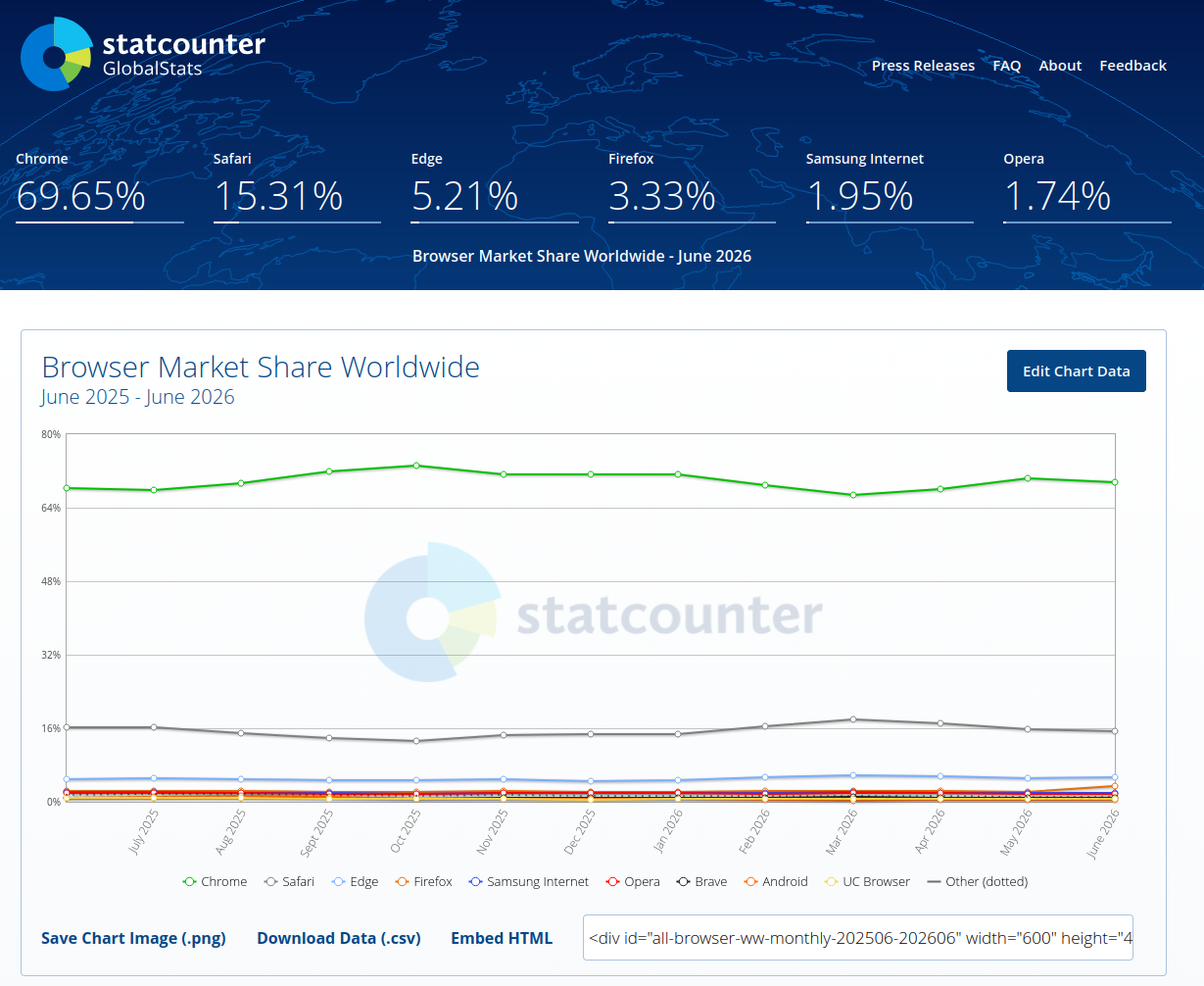
The screen-shot above shows the makeup of Internet browsers for a period ending June 2026 - the most up-to-date information available at the time of publication, and includes mobile browsers, desktop browsers, and all browsers in between. (I notice neither CURL or LYNX show up in these lists...) What this really shows us is that more than 75% of the browsers in the world are both based on Chromium AND owned by companies that make a significant portion of their money off of advertising and tracking activities. A further 15% is owned by Apple, who has their own walled garden ecosystem, but has shown a more privacy focused view than the other two. That leaves less than 10% that aren't owned by one of those three organizations, and that doesn't count independent browsers like Opera that are based on Chromium as well, but are more privacy focused.
Manifest v3's Impact
So given that more than 75% of browsers used worldwide are based on the underpinnings of Chrome, and Google has declared that Manifest v3 is being implemented, you can see how the decision made by one corporation who makes a significant portion of its money off of advertising and tracking unilaterally impacts users all over the world. Even browsers built off of Chromium (the open-source browser that Google uses as the basis for Chrome) that wish to be privacy focused are going to be forced to do one of the following:
- Accept Manifest v3 and try to create workarounds. This means significant increases in R&D to keep up with compatibility issues and to keep up with privacy workarounds.
- Not accept Manifest v3 and have to fork their own development team away from updated Chromium releases. This means significant increases in R&D to keep up with security bugs, compatibility issues, etc.
- Close up shop, handing more market share over to the Chromium ecosystem without privacy and security protections in place.
Your Options
Your best option for continuing the fight against obtrusive ads and insidious tracking is to choose to move to a browser that doesn't require Manifest v3. There are literally hundreds of options out there, but here are three you may have heard of that are worth considering.
Mozilla Firefox
This is the direct descendant of one of the very first browsers: Netscape. It makes up just over 3% of the browser market already, and is available for Windows, MacOS, iOS, Android, and Linux. Firefox supports extensions written against both Manifest v2 and v3, but does so out of convenience - it is not based on the Chromium browser and therefore is responsible for its own destiny.
In recent years and months Firefox has been getting dinged for how the Mozilla organization is approaching things like AI, but at least everything in Firefox is configurable: if you want to try the AI you can, if you don't you can shut it down.
Firefox is my browser of choice on Linux.

DuckDuckGo
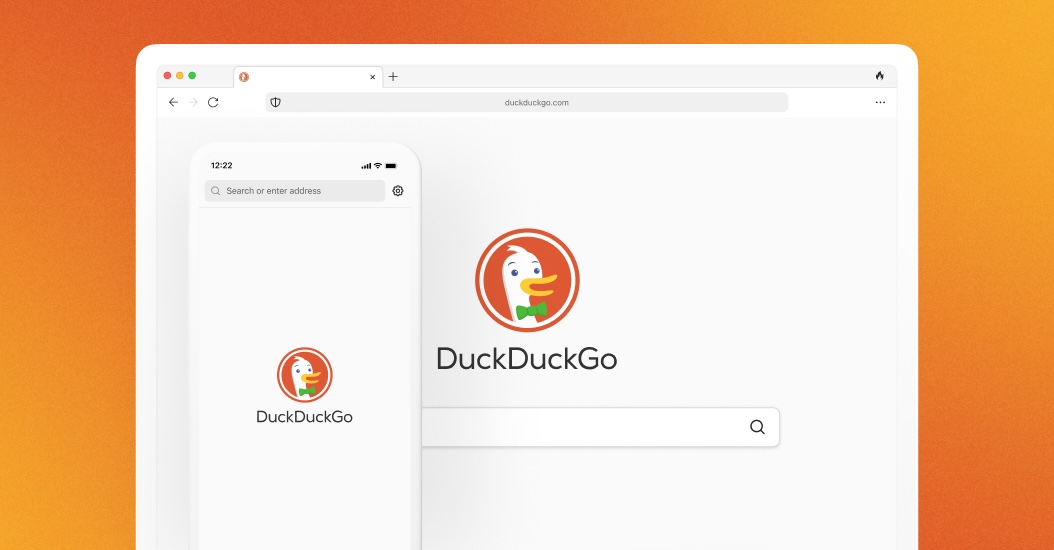
DuckDuckGo's market share is so small that it doesn't even register on the chart above, but it is my go-to for Android, Windows, and Mac based browsing. DuckDuckGo is extremely privacy focused, and has improved that capability in the past couple of years. Unfortunately it does not support extensions, but by default is blocks what you want blocked from a privacy perspective. Because of the lack of extensions and the focus on built-in privacy, this Manifest v2/v3 kerfuffle is a nothing burger for DuckDuckGo. The biggest drawback for me s that there is no Linux browser, nor is there one on the horizon.

Safari
In recent years Apple has started marketing their privacy focus. Like Firefox, Safari supports both Manifest v2 and v3 out of convenience for developers and users alike, and has no announced plans to drop v2. If you're using Mac hardware you can certainly choose to continue to use Safari for your primary browser, but you may want to investigate the other two I mentioned above.
Many, Many More
Many of you out there will point out I've ignored other names such as Brave, Opera, Vivaldi, and many, many more. You're correct. And I'm not going to do a disservice to my readers by pretending I know enough about them to render an informed opinion. That's a little like my approach to discussing Linux flavors: I know several, know a few extremely well, and have no informed opinion about the rest. There are just too many to inventory all of them - I have other things to focus on.
But this is really more a call to action. The only way to get Google (and to a lesser extent, Microsoft) to change their tune is for them to see a serious dip in browser use, the sooner the better.
Yes, I'm making product recommendations. But more importantly I'm asking you to leave Chromium, Chrome, and Edge immediately.
I know, you're probably forced to use a specific browser by your employer. I absolutely understand that. But your employer doesn't own your phone, or your personal computers. You have the opportunity to make your opinion heard by the simple act of installing and using a new browser. Isn't that just a fantastic power to have?